
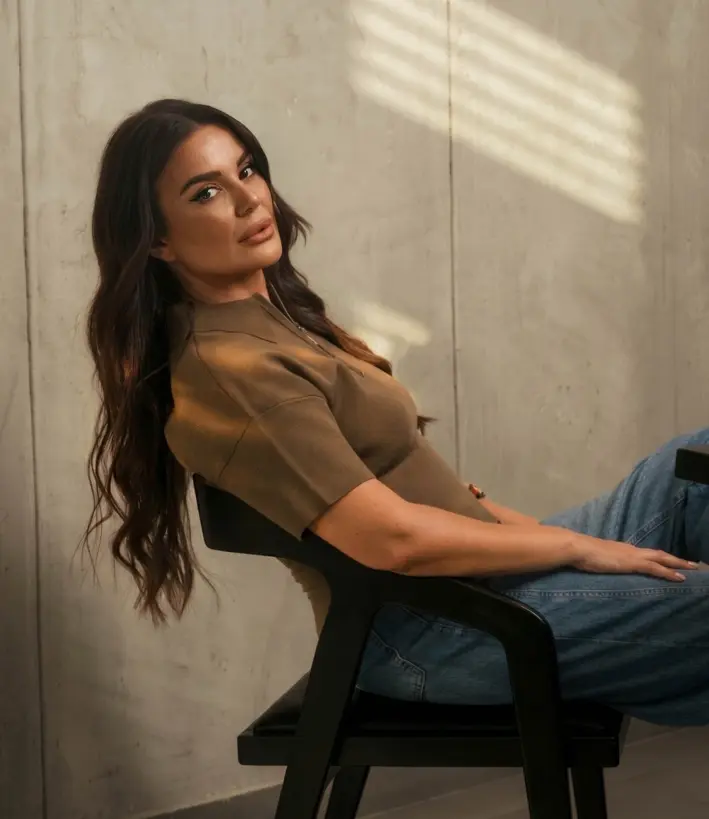
Jelena Milovanovic
Founder & CEO Of BioEridan
- Let’s start with your journey—can you tell us how you began and what led you to your current leadership role?
- Along the way, what motivated you to keep pushing forward, and which values guide the way you lead today?
- Every path has its challenges—can you share one defining moment in your career and how you overcame it?
One defining challenge was moving from being a scientist with an idea to becoming a founder responsible for turning that idea into a company.
Science and entrepreneurship require different kinds of courage. In research, you learn to defend a hypothesis with evidence. As a founder, you also have to defend a vision before all the evidence, infrastructure and resources you ultimately want are available.
Fundraising was particularly formative. Being a female founder building a biotechnology company in the Balkans meant entering rooms where there were very few examples of people who looked like me or companies like mine.
Instead of allowing that to reduce my ambition, I concentrated on what I could control: knowing my science, understanding the business, building evidence and communicating clearly why the technology deserved attention. Securing VC investment became an important milestone, but the deeper lesson was that credibility is built long before someone signs an investment agreement.
- Innovation and collaboration are key to success. How do you cultivate these within your team or organization?
- From your perspective, what traits or habits distinguish top-performing leaders from the rest?
- Mentorship and learning can shape a leader profoundly. How have they influenced your growth, and how do you encourage them in your team?
- The market and customer needs are always evolving. How do you keep your organization aligned and agile in this changing environment?
- Looking back, is there a particular experience or lesson that significantly shaped your leadership style?
- What advice would you share with emerging leaders who want to make a meaningful impact in their industry?
- Finally, looking ahead, what excites you most about the future—both for your organization and the industry as a whole?
My journey has always been driven by curiosity about nature and by one fundamental question: how can we understand biological systems deeply enough to create solutions that improve human life without working against nature?
My academic background began in ecology, and over time my research increasingly brought me toward biotechnology and genetic engineering. That intersection eventually became the foundation for BioEridan, the biotechnology company I founded and now lead as CEO.
At BioEridan, we are exploring bioactive compounds and plant-based biotechnology in the context of healthy aging and longevity, including research connected to telomere biology. One of the most unusual aspects of our approach is our work with plants cultivated in controlled underwater environments, at depths of approximately 30 meters. We study how environmental stressors and specific conditions, including iodine exposure, can influence plant biology and the compounds those plants produce.
Building BioEridan required me to become more than a scientist. I had to learn how to translate research into intellectual property, strategy, investment, products, and ultimately a company. Becoming the first woman to secure an investment from a VC fund in the Balkans was an important milestone for me, but what matters even more is what it represents: scientific ideas from our region can become globally relevant biotechnology companies.
Alongside BioEridan, I founded Eridan Beauty, where I bring together nature, biotechnology and skincare. Both companies are expressions of the same philosophy: nature contains extraordinary biological intelligence, and science gives us the tools to understand and use it responsibly.
What keeps me moving is purpose. I am fascinated by what we still do not know.
When you work in science, particularly in areas such as aging and biotechnology, uncertainty is part of your everyday life. An experiment can challenge your hypothesis. A business plan can change. Investors can say no. Regulations and markets evolve. You need a reason for continuing that is stronger than external validation.
My leadership is therefore built around curiosity, resilience, scientific integrity and courage. I encourage my team to question assumptions, including mine. In biotechnology, being wrong can sometimes be extremely valuable, because an unexpected result may reveal something more interesting than what you originally intended to discover.
I also believe ambition and responsibility must coexist. If we want to work on technologies that could influence human health and longevity, scientific rigor cannot be optional.
I don’t believe innovation comes from telling intelligent people exactly what to think. It comes from creating an environment where they can ask difficult questions.
At BioEridan, science is at the center of our culture. We combine different disciplines and encourage people to look beyond the boundaries of their own specialization. Biology, ecology, biotechnology, genetic engineering and business may appear to be separate worlds, but some of the most interesting ideas emerge where those worlds intersect.
I also want people to feel comfortable saying, “The data doesn’t support our assumption.” That sentence isn’t a failure. In a research-driven company, it can be the beginning of the next discovery.
Intellectual curiosity, discipline and the ability to remain effective in uncertainty.
A leader cannot know everything, particularly when building a science-based company. I think one of the greatest mistakes a CEO can make is believing that leadership means always having the answer.
My responsibility is to ask good questions, surround myself with people who know things I don’t, make decisions when information is incomplete, and change those decisions when better evidence appears.
I also value consistency. Extraordinary companies are rarely built through one extraordinary day. They are built through thousands of ordinary days in which people continue doing difficult things well.
I consider myself a permanent student. My academic journey reflects that: even while building companies, I have continued pursuing advanced research in biotechnology and genetic engineering.
But education isn’t limited to universities. I have learned from scientists, entrepreneurs, investors, colleagues, mistakes, experiments and conversations with people whose expertise is completely different from mine.
Within my team, I want knowledge to move horizontally rather than only from senior people downward. A young researcher can see something that an experienced executive misses. Leadership should create an environment where expertise matters more than hierarchy.
Biotechnology requires an interesting balance. You need to move quickly as a company without asking science to move faster than evidence allows.
We continuously observe scientific developments, consumer needs, regulation and the broader longevity and biotechnology landscape. But I don’t believe in changing direction simply because something becomes fashionable.
Our foundation remains science. We ask whether a development genuinely changes our understanding, whether it creates an opportunity for our technology, and whether it ultimately provides meaningful value.
That allows us to be agile without becoming reactive.
Fundraising changed me significantly.
When you present something genuinely new, people will inevitably tell you why it cannot work, why the market isn’t ready or why someone from your geography or background is unlikely to build it.
I learned to distinguish between valuable criticism and other people’s limitations of imagination.
Good criticism makes your science, strategy or company stronger. I actively seek it. But skepticism by itself is not evidence.
That distinction has shaped how I lead. Listen carefully. Examine the evidence. Change your mind when the evidence demands it, but don’t abandon a meaningful vision simply because it is difficult for other people to imagine.
Become extremely good at something before becoming obsessed with being recognized for it.
We live in an era in which visibility can sometimes look like achievement. They are not the same thing.
Build knowledge. Do the research. Understand your industry deeply. Find people who challenge you intellectually. Learn how money works, even if you are a scientist. Learn how science works, even if you are an entrepreneur.
And don’t wait until you feel completely ready. If your ambition is genuinely innovative, there will probably never be a moment when every variable is known.
Confidence should not mean believing you cannot be wrong. It should mean knowing that you are capable of learning when you are.
What excites me most is that we are entering a period in which our understanding of aging is becoming increasingly molecular and increasingly actionable.
For BioEridan, I am particularly excited about advancing our research into plant-derived bioactive compounds and investigating their potential relevance to mechanisms associated with cellular aging, including telomere biology. Our underwater cultivation platform also gives us an unusual experimental environment for studying how plants respond and adapt to specific biological and environmental pressures.
My long-term vision goes beyond a single ingredient or product. I want BioEridan to become a biotechnology platform capable of translating biological discoveries into technologies with real world applications.
With Eridan Beauty, I want to demonstrate another side of the same idea: nature and advanced biotechnology do not need to be opposites. The future can be both scientifically sophisticated and deeply connected to the natural world.
Ultimately, longevity should not simply be about adding years to life. The more meaningful scientific challenge is extending the years in which people can remain healthy and functional.
That is the future I want to help build.